
The pitch starts with a familiar frustration
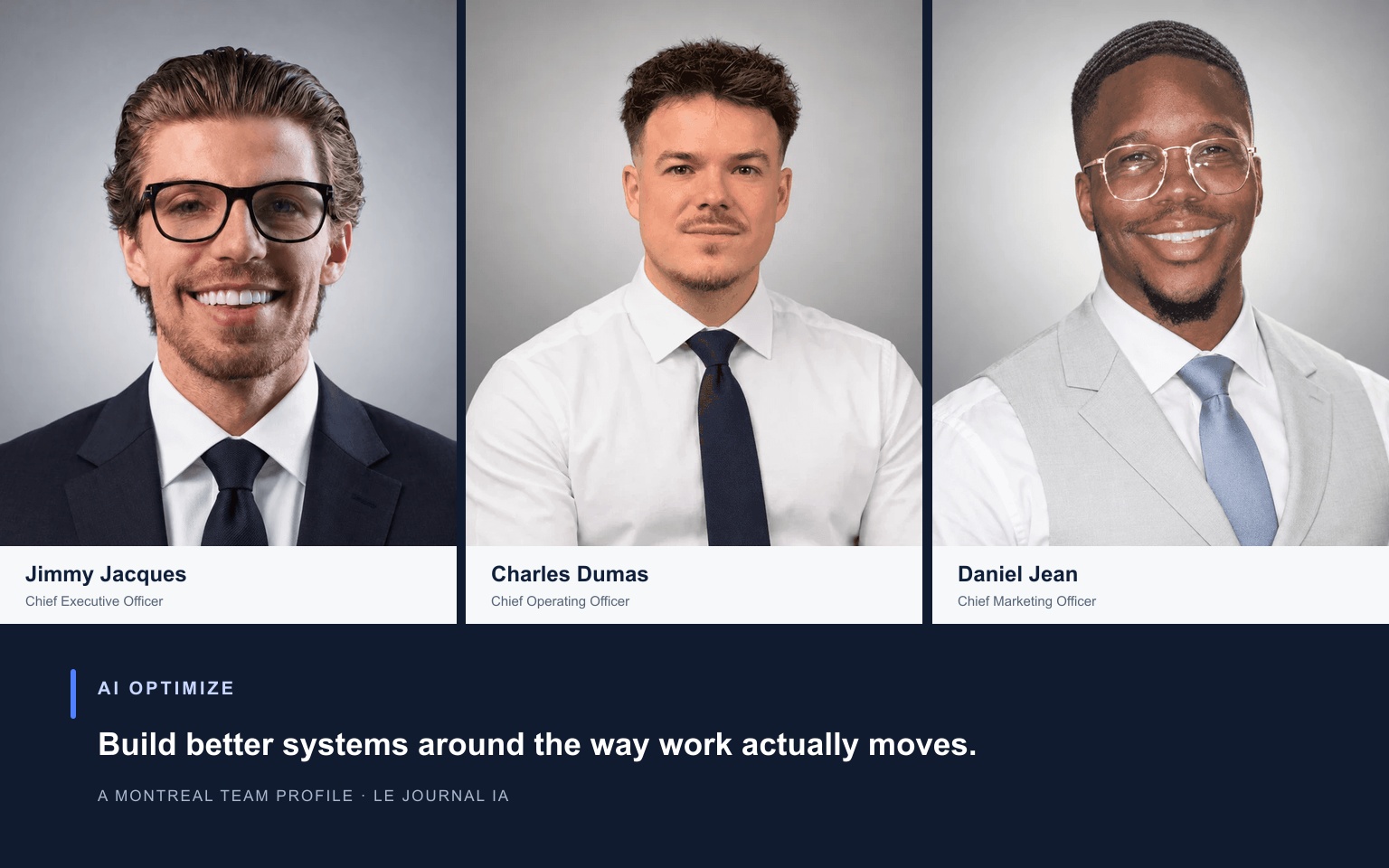
A growing company can have a customer relationship system, project software, forms and a new AI subscription, yet still depend on one person to remember the next step. A quote waits for approval. A file is copied from one tool to another. A customer who should have received a follow-up slips through the cracks. AI Optimize, a Montreal-based automation consultancy, has built its public pitch around that gap between buying software and changing how work actually moves. The team’s website describes a four-person group spanning company leadership, operations, marketing and sales. It says it works across Canada and the United States, with a focus on businesses reporting between US$1 million and US$50 million in annual revenue. Construction and trades, mortgage brokerages, marketing agencies, staffing, consulting and other service businesses appear among its target sectors. These are the company’s own descriptions, not independently audited client or market data. Disclosure: AI Optimize and Le Journal IA are part of the same business ecosystem. This profile examines the company’s published approach; it is not an award announcement or an independent client-outcomes study.
Map one job from first contact to payment
AI Optimize says its first step is to follow a real piece of work through the business, from the first enquiry to the paid invoice. The team looks for waiting, re-keying information, repeated approvals and steps that happen only because someone remembers them. It then puts hours and dollars against those friction points and returns a written picture of what it found. The company currently presents this initial audit as free, though the offer and its terms can change. That sequence is more useful than beginning with a list of AI tools. Imagine a renovation contractor receiving a website enquiry. Someone checks the service area, asks for missing measurements, prepares a quote, schedules a visit and follows up. A tool can help sort the enquiry or draft a response, but only if the business has agreed on who qualifies, what information is required and when a human must step in. Otherwise, automation can make a confusing process move faster without making it better. AI Optimize’s own method explicitly allows for deleting a step or clarifying a disagreement before building anything. That restraint is a sound principle: automate a stable decision, not a contradiction between two versions of the process.
Build narrowly, then hand over the controls
For the first system, the company says it chooses the process with the clearest cost and builds it narrowly. The new workflow runs alongside the old one while the client watches real work pass through it; the existing method is retired only when the client is satisfied that the replacement holds. This staged approach reduces the chance that an untested assistant quietly becomes the only route for urgent work. The handover is another important part of the offer. AI Optimize says client accounts, code and data are held in the client’s name from the start. It also describes a dashboard, a written map of the automation and an alert when something fails. In practical terms, those promises should be translated into a checklist before a contract is signed: who owns each software account, where credentials live, how the system can be paused, who receives failure alerts, and what documentation is delivered. A small pilot can make those answers visible. If an assistant classifies incoming requests, for instance, staff should be able to see the source message, the suggested category and the reason for escalation. Exceptions need a clear human owner. A dashboard is useful only when it helps someone decide what to do next.
A disciplined idea still needs measurable evidence
The workflow-first thesis is attractive because it shifts attention from novelty to operating costs. But a good method is not the same thing as proof that a particular implementation saves money or improves service. AI Optimize’s public site makes broad statements about its experience and reach, while the materials reviewed for this profile do not provide independently audited before-and-after results for a representative project. The company’s own terms also say that AI outputs are probabilistic, require review and do not guarantee business outcomes unless a signed agreement says otherwise. That distinction matters when evaluating any consultant. Before a pilot, a business should record a baseline: how many requests arrive, how long they wait, how often information must be re-entered, how many are sent back for correction, and how much staff time is spent on exceptions. The team can then agree on a narrow success measure, such as reducing median response time without increasing incorrect quotes. A percentage improvement without the starting volume, measurement period and error rate is hard to interpret. There is also a limit to what a public company profile can establish. AI Optimize’s process pages explain what it says it does; they do not let an outside reader inspect client contracts, system logs, privacy assessments or production outcomes. Those questions belong in a buyer’s due diligence, not in an assumption based on polished marketing.
Questions to ask before the first workflow goes live
A practical conversation with an automation partner should begin with a single recurring job and the people who perform it. Ask the team to draw the current path, including the awkward cases that staff handle from memory. Confirm which decisions are rules and which require judgment, what data is essential, and which systems are allowed to receive it. If employees describe the process differently, resolve that before asking software to choose between them. Then define guardrails. What can the system prepare automatically, and what must a person approve? How will the team catch a missed handoff or a confident but incorrect answer? Can a worker return to the old process during an outage? What happens when the engagement ends, and can the business continue operating without the consultant? These questions are especially important when customer, financial, health or employment information is involved. AI Optimize’s strongest public idea is not that a model can replace a team. It is that a small, observable system can take repetitive coordination off people’s hands while leaving ownership and oversight clear. Whether the company delivers that value for a particular business can only be established through a well-scoped pilot, transparent measurements and a handover the client can actually use.